How well do you know Dickens’s treasured holiday tale?
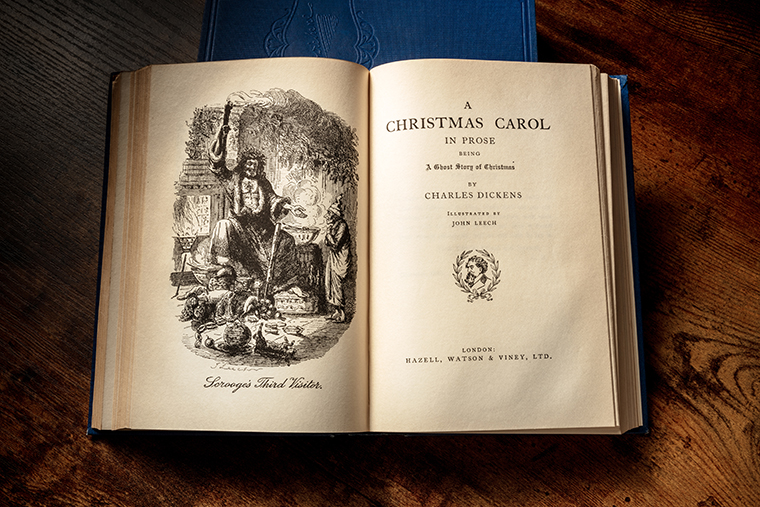
Published in 1843, Charles Dickens’s A Christmas Carol is as classic as it gets. The beloved story about a miserly man transformed by three spirits on Christmas Eve has been shared, performed, and adapted countless times over the last 180 years, becoming synonymous with the holiday season itself. Even if you’ve never read a word, you remember the story by heart.
And yet, despite its enduring popularity, you might not know everything there is to know about Dickens’s Christmas novella. So come in and know us better, man. Let’s discover some surprising facts about A Christmas Carol together!
“Bah! Humbug!” appears only twice.
Ebenezer Scrooge, the protagonist in Dickens’s tale, is a notorious grinch — he’s so known for his holiday disdain, in fact, that his unmerry catchphrase is now a common colloquialism. Yet despite being one of the most-quoted lines from A Christmas Carol, “Bah! Humbug!” appears a mere two times across the novella’s roughly 100-page length. You’d expect a slogan so iconic to pop up regularly. It seems Dickens didn’t need to rely on repetition to leave a lasting impression.
Dickens wrote A Christmas Carol in just six weeks under financial pressure.
In October 1843, Charles Dickens was in a pinch. Even though he had already established himself as a successful author, his most recent serialized novel, Martin Chuzzlewit, was underperforming, and his publishers were on the verge of reducing his salary. With his wife and four kids at home, plus a baby on the way and his father to support, Dickens was desperate to produce something new — and get it out fast.
After an inspiring evening at a charity event (more on that below), Dickens set to writing, workshopping the new narrative in his head during long nighttime walks through London. He completed A Christmas Carol in just six weeks, finishing it by early December. The novella hit shelves on December 19, 1843.
Dickens wowed audiences with his public readings — and A Christmas Carol was a fan favorite.
Dickens’s public readings were legendary. Indeed, the author was something of a pioneer in delivering written works before a live audience, elevating the event to a stage performance. One of his favorite texts to read and perform? Why, A Christmas Carol, of course!
During Christmas 1853, Dickens gave his first public reading of A Christmas Carol for charity, delivering it before a rapt audience of 2,000 at the Birmingham Town Hall in England. Dickens specifically requested that tickets be reserved at a discounted price so working-class individuals could attend.
The reading was a smash success. In fact, Dickens was so committed to the performance that he created a special version of A Christmas Carol specifically for live events, complete with stage directions scribbled in the margins to aid him in his delivery. This version is referred to as a “prompt copy.” There’s at least one of these remarkable prompt copies still in existence — it’s part of the Berg Collection at the New York Public Library.
Though A Christmas Carol was a hit, Dickens didn’t make much money from it.
A Christmas Carol was published on December 19, 1843. Six thousand copies were printed in its first run, and by Christmas Day, they had entirely sold out.
If Dickens was still smarting over the lackluster response to Martin Chuzzlewit, the overwhelming success of A Christmas Carol certainly offered a mood boost. And yet, Dickens was meticulous in how his book should look. He preferred high-end print details, such as gilt lettering, deluxe binding, and color illustrations. As a result, the production costs for A Christmas Carol were high, and the author didn’t actually make much of a profit.
Dickens went on a book tour to America with A Christmas Carol, and Mark Twain attended.

Dickens did, however, earn a very handsome profit from his book tour in the United States. From December 1867 to April 1868, the author traveled America to read selections from A Christmas Carol and The Pickwick Papers, among other works, with enthusiastic fans camping out in the cold in hopes of securing a seat. The sensational tour earned him over £19,000 — a massive amount of money at the time, and a great deal more than he made in book sales.
Among the many attendees of Dickens’s readings in the States was Mark Twain. In a letter to the Alta California, the renowned American author and humorist lauded Dickens’s imaginative talents, describing his mind as a “wonderful mechanism.” In the same letter, though, Twain wrote that despite “the beautiful pathos of language,” he was unimpressed with Dickens’s reading, remarking that “there is no heart, no feeling in it — it is glittering frostwork.” Twain even mentions that his date was disappointed with the performance (ouch, tough crowd).
Dickens was inspired to write A Christmas Carol after speaking at a charity event.
Dickens had been a child laborer himself, and he passionately advocated for improving the lives of the poor in England, particularly children. In early 1843, he read a parliamentary report about the lamentable conditions for children in the workforce. This spurred him to speak at a charity event later that year for the Manchester Athenaeum, raising money for the institution, which advocated for education for all classes.
It was a transformative evening. The event inspired Dickens to write A Christmas Carol — a story that highlights the undue challenges faced by the poor and illustrates how generosity and the distribution of resources can transform the lives of those less fortunate.
There’s a staggering number of Christmas Carol film and TV adaptations out there — the Internet Movie Database says more than 200!
In the 180-plus years since its publication, A Christmas Carol has been told and retold, with fresh film and TV adaptations of the story popping up nearly every year when the holiday season rolls around. An Internet Movie Database (IMDb) roundup titled “A Christmas Carol — All Versions” currently lists 230 adaptations, the earliest being a 1901 six-minute short called Scrooge; or Marley’s Ghost and the most recent being the not-yet-released feature film Ebenezer: A Christmas Carol, expected in 2026.
From The Muppet Christmas Carol and Disney’s iconic Mickey’s Christmas Carol featuring Scrooge McDuck, to darker reimaginings like the gritty three-part BBC miniseries starring Guy Pearce, Dickens’s tale has inspired a bounty of creative interpretations over the years. Movie marathon, anyone?
A Christmas Carol helped popularize the phrase “Merry Christmas!”
While Dickens can’t claim to have coined the phrase “Merry Christmas,” he can be credited with solidifying its position as the top holiday greeting. The first recorded use of the phrase dates back to 1534, when it appears in a letter from Bishop John Fisher to Thomas Cromwell. But it really gained momentum in the Victorian era and rose in popularity thanks to Dickens’s influential bestseller. The festive greeting appears 21 times in A Christmas Carol and soon became a seasonal standard, helped along by the novella’s widespread readership.
It’s not the only Christmas story from Dickens.
Production costs aside, A Christmas Carol was a success — and both Dickens and his publishers were eager to build on the momentum.
Between 1843 and 1848, he published five Christmas books in total. A Christmas Carol (1843) was followed by The Chimes: A Goblin Story of Some Bells that Rang an Old Year Out and a New Year In in 1844. In subsequent years, Dickens published The Cricket on the Hearth: A Fairy Tale of Home (1845), The Battle of Life: A Love Story (1846), and The Haunted Man and the Ghost’s Bargain (1848).
The books offered a welcome source of income for the author. They also provided him with a platform to express his strong social conscience and to advocate for compassion, urging readers to open their hearts, take care of their neighbors, and keep the holiday spirit alive throughout the year.