
A life in the arts is often viewed in stark terms: If you really want to be an artist, you’ll have to choose between chasing your dreams or paying your bills.
But this exaggerated notion isn’t just outdated — it’s historically inaccurate.
Throughout history, successful writers, painters, and musicians have funded their passions through an array of day jobs, side hustles, and remarkably inventive gigs. Not only did these jobs support the artists financially, they also enriched their creative outlook on life. After all, art needs to, you know, be about something. What better way to infuse meaning in your art than by building skills and cultivating real-world experiences outside of the studio?
This illuminating truth is at the core of Making Art and Making a Living: Adventures in Funding a Creative Life by Mason Currey. Currey’s entertaining and eye-opening new narrative explores the many ways artists have covered rent and earned a living, from temp jobs to far more inventive arrangements.
The book is packed with insights into the creative lives of more than 40 artists, including Franz Kafka, Lee Krasner, Virginia Woolf, John Cage, and Vincent van Gogh. It’s also a valuable reminder that even the greats had bills to pay — and you’re still an artist if you sing, paint, or write while working other jobs.
Below are just a few of the funny, surprising, and downright dangerous ways artists paid their bills that you’ll find in Currey’s new book. Grab a copy of Making Art and Making a Living to discover the rest!
1. The Fine Art of the Side Hustle: Roberto Bolaño, Grace Hartigan, and John Cage
The term “side hustle” might be a relatively recent addition to our collective vocabulary, but the notion is anything but.
Indeed, working odd jobs to support your art is a tale as old as time. Many artists throughout history have pursued traditional gig work to keep money flowing. Chilean poet and novelist Roberto Bolaño wore a number of hats throughout his career, from dishwasher and longshoreman to waiter and receptionist. Grace Hartigan, one of the most important American abstract artists of the mid-20th-century, preferred temping over working a 9-to-5, as it paid her a living wage while giving her time to paint.
Other artists held odd jobs that were indeed quite atypical. At the age of 19, composer John Cage developed a door-to-door speaking circuit of sorts, offering ten lectures on art and music for $2.50 to housewives in Santa Monica. Later in life, while foraging to supplement his diet, he stumbled into becoming an amateur mycologist and eventually a mycology instructor for curious people interested in mushroom identification.
His expertise in fungi brought him further success when he appeared on an Italian quiz show in 1959 that tested contestants on a topic of their choice. Naturally, Cage chose mushrooms. As Currey tells it: “The forty-six-year-old composer walked away with five million lire, or about $8,000 dollars — almost $90,000 at present-day values; it was, Cage said, ‘the first consequential amount of money I’d ever earned’ — which he used to purchase a Steinway piano for himself” (page 195).
2. Working for the Government: Willem de Kooning and Lee Krasner
In an era of funding cuts to the arts, it’s worth remembering that some of the world’s greatest artists only got that way with the help of investment from the government. Currey notes that Willem de Kooning and Lee Krasner — foundational figures in America’s Abstract Expressionism movement — both got their start employed by the Federal Art Project, a New Deal program that invested in public art and sustained thousands of artists from 1935 to 1943.
De Kooning left behind odd jobs as a house painter and freelance commercial artist to paint for the program, which not only provided him a lifeline in the midst of the Great Depression but also helped develop his artistic style. When De Kooning stepped away from a mural-in-progress, Lee Krasner stepped in to complete the work, leaving behind her former life as a nightclub hostess. Both artists later credited their time in the Federal Art Project as essential to jump-starting their art careers.
3. Great Artists Steal: Jean-Luc Godard and Jean Genet
Legendary French New Wave filmmaker Jean-Luc Godard was born into a wealthy family but was cut off when it became clear he wanted to pursue filmmaking rather than a more traditional career. So, to get by, Godard turned to theft. A lot of theft.

He “borrowed” cash from his mom’s close friend with no intention of paying it back. He stole and sold his grandfather’s rare books and works of art. He stole from his day jobs. He even pinched from the influential film criticism journal Cahiers du Cinéma while writing for it! He was as brazen in his theft as he was in upending the stuffy norms of French cinema. As Currey points out in his chapter on Godard, though, the privileged filmmaker never found himself in too much trouble, thanks to his family’s connections.
Godard wasn’t alone in pilfering books for cash. Novelist and playwright Jean Genet also earned a living by stealing and reselling valuable secondhand editions of books, which landed him in prison several times. Prison turned out to be a boon to Genet’s creative pursuits, though, “because it gave him lots of time to read — the most essential training for any writer” (page 166). He even wrote his first two novels in prison! Talk about turning lemons into lemonade…
4. When in Doubt, Lean on Your Loved Ones: Vincent van Gogh and James Joyce
Some artists are lucky enough to have a relative who can support them financially, and it isn’t always a parent or grandparent. Vincent van Gogh famously relied on his younger brother Theo’s generosity throughout his career. After failing to follow in his uncle’s footsteps in the art trade and short stints as a preacher and teacher, Van Gogh focused on painting. But, as a temperamental artist who, as Currey puts it, was incapable of “living in any kind of rational, dependable, and orderly way” (page 54), he relied on an allowance from his brother, which he frequently squandered and complained in his letters was not high enough. Sadly, neither Van Gogh nor his brother got to see the investment pay off. It was up to Theo’s widow to champion Van Gogh’s work, which, over time, rose to epitomize artistic greatness.
James Joyce was another artistic great buoyed by financial support from a sibling. Like Van Gogh, Joyce’s life was…a bit of a mess. Joyce’s brother, as Currey puts it, “would all too often be the only thing that stood between Joyce and total dissolution” (page 50), getting him out of debt, out of bars, and out of all manner of other trouble. Joyce’s brother also convinced the author to quit drinking, which proved crucial to his productivity and arguably led to the eventual success of his writing.
Joyce and Van Gogh are important reminders that artistic greatness doesn’t happen in isolation. It’s the collective effort of countless (often overlooked) supporters!
5. The Double Life of a Day Job: Franz Kafka and William Carlos Williams
Writer Franz Kafka excelled at capturing the dark absurdities of modern bureaucracy and worker-drone drudgery in his fiction. What you might not know, however, is that Kafka wrote from experience. He worked as an insurance man.
Kafka originally went to law school because “he thought it would afford him the best chance of being able to write fiction in his free time” (page 88). Unfortunately, he was a terrible law student. After a few false starts, he landed a new job: working from the morning to early afternoon for the Workers’ Accident Insurance Institute. His schedule allowed him to work during the day and write in the evenings.
For years, Kafka complained in letters that he longed to pursue writing more fully, but he never actually changed his circumstances. Currey notes that this experience likely filtered into Kafka’s fiction, which features characters who often “yearn for freedom […] but who do not choose it, either because they doubt its reality or because they ultimately prefer their constrained position” (page 93).
A day job doesn’t have to be so dour, however. Famed poet William Carlos Williams was also a physician. He enjoyed the work immensely, viewing it as a way to create the kind of stable life many writers struggle to access. It also enriched his poetry. “it acquainted him intimately with his fellow humans, and that up-close exposure proved indispensable to the poet he became” (page 83).
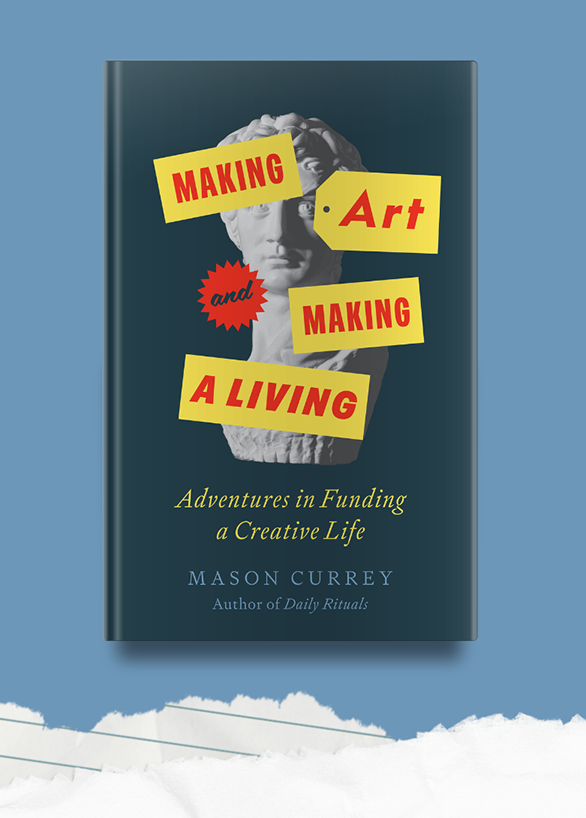
Making Art and Making a Living
“Mason Currey is the undisputed master of finding, in the messy lives of great artists and thinkers throughout time, deeply human lessons about cultivating meaning in our current age.” ―Cal Newport, New York Times bestselling author of Slow Productivity and Deep Work
Daily Rituals author Mason Currey weaves together delightful, illuminating stories and reflections about how famous artists, writers, musicians, and filmmakers throughout history have managed to successfully (or not) support a creative life.